


The Nuremberg Trials, held after World War II, were meant to open a new chapter in international justice. Inside the Vatican, however, church leaders pursued a different agenda.
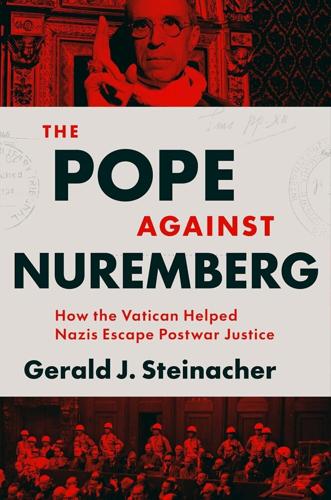
In his new book, “The Pope Against Nuremberg: How the Vatican Helped Nazis Escape Postwar Justice,” University of Nebraska–Lincoln historian Gerald J. Steinacher explores the Vatican's response to the Allied countries' prosecution of Nazi war criminals. The monograph was published in early November by NYU Press.
Although historians have written a great deal about the Nuremberg Trials, the Vatican’s stance and reaction to war crimes trials and denazification have so far received very little attention. The recent opening of the Vatican archives (formerly known as the Vatican Secret Archives) for the pontificate of Pius XII now offers a view behind the Vatican walls.
People are also reading…
Drawing on those Church records as well as on intelligence files and other sources from more than 60 archives in Europe and the Americas, Steinacher, James A. Rawley Professor of History, reveals how Catholic officials tried to shield Nazi perpetrators from prosecution. Papal diplomats and individual bishops wrote petitions to Allied leaders, worked closely and tirelessly with the defense, organized press campaigns against the trials and opposed extraditions. Some clergy even hid Nazi and fascist war criminals on church premises.
Pius XII, frequently faulted for his public silence about the Holocaust, was vocal after 1945 when it came to speaking up for Nazi perpetrators. The Vatican criticized the trials from the start, and its opposition only grew as the war crimes trials and denazification went on. In the end, it called for a generous amnesty and asked the world to forgive and forget Germany’s crimes and to help rebuild the country. In the book, Steinacher sets these efforts against the backdrop of the early Cold War, when fear of communism increasingly mattered more than holding the perpetrators of mass crimes to account.
The book is the result of 10 years of research. Historian and Pulitzer Prize winner David I. Kertzer, author of “The Pope at War,” called it “a true tour de force.”
Eighty years after the Nuremberg verdicts, the book speaks to a question that remains urgent today: How can societies move on after dictatorship, war and genocide?
“World War II and the Holocaust left behind immense suffering, and there was no simple way forward,” Steinacher said. “The Allies chose punishment. War crimes trials and denazification were meant to break with the Nazi past and to show people what crimes the regime had committed. Nuremberg was as much a classroom as a courtroom. Not every perpetrator could be tried, and Allied crimes never came before the court. But simply forgetting and pardoning ignored the victims. For many of them, justice was done at Nuremberg, even if it was imperfect.”
Nuremberg was also meant to look ahead. The American architects of Nuremberg hoped to set new standards of international law that would deter future dictators from dragging their countries into another war.
“Instead of a jungle where the strongest rule, the Americans behind Nuremberg envisioned an international order grounded in the rule of law,” Steinacher said. “It was not a perfect project, but its standards were meant to apply to everyone in the future, victors as well as vanquished. The lesson from Nuremberg is clear: the international order must rest on the rule of law, with no one above it. Even the most powerful heads of state and military leaders must be held accountable for their crimes.”
A presentation in Lincoln is planned for later this year, and a book tour across the United States and Europe will follow in early 2027. A scholar of the Holocaust, Nazi Germany, and Fascist Italy, Steinacher has published 18 authored or edited books and more than one hundred articles and book chapters. His book, “Nazis on the Run: How Hitler’s Henchmen Fled Justice” (Oxford University Press, 2011) received the National Jewish Book Award in the Holocaust category. He is also the author of “Humanitarians at War: The Red Cross in the Shadow of the Holocaust” (Oxford University Press, 2017). Steinacher has held numerous fellowships and visiting professorships, including at Harvard University, in Jerusalem, Venice, Munich and Vienna, and at the Australian National University. His research has been featured in The Washington Post, The New Yorker, and Der Spiegel.


