


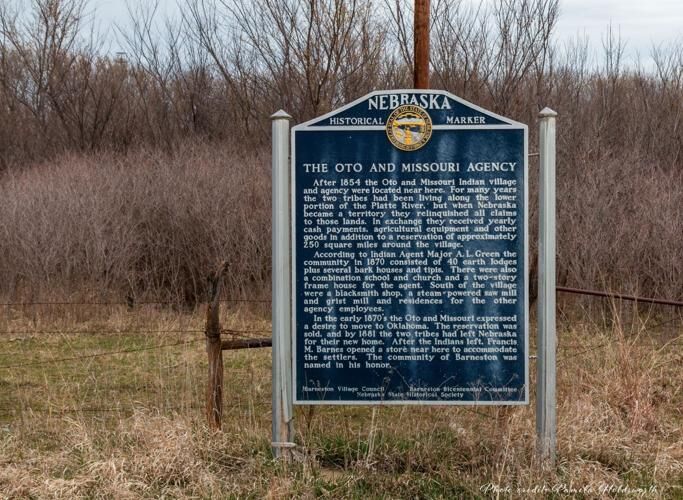


Before Barneston was platted and organized in 1884, the Otoe-Missouria tribe occupied the Big Blue Reservation in the area.
An exhibit at the Gage County Historical Society and Museum tells a story of the native people.
“We have information from the tribe and the agent,” said director Cassandra Dean. “It tells both sides of the story.”
The Otoes and Missourias are related to each other in language and customs but are two distinct people. The tribes originated in the Great Lakes Region of the United States.
The Otoe-Missouria lived in earth lodge villages and also used tipis and bark lodges. They hunted bison, gathered plants and grew corn, beans, pumpkins and squash.
In the spring of 1804, Meriwether Lewis and William Clark entered an empty village of the Otoe-Missouria tribe. They waited for the tribe to return from a hunt. A council event took place on Aug. 3, 1804, at Fort Calhoun, Nebraska.
People are also reading…
Six treaties were established, with the 1854 treaty placing the tribe on the Big Blue Reservation near present-day Barneston.
The reservation covered 250 sections in various townships. The west end of the reservation extended into present-day Jefferson County. The southern end extended 2 miles into Kansas.
Life on the reservation was hard. The government encouraged a shift from a migratory lifestyle to an agricultural one without consideration of the long-established tradition or social structure. The tribe suffered as treaties were broken and food, medicine, livestock and basic essentials were not delivered as promised. Sickness was rampant, children starved, and the mortality rate climbed higher year after year.
The federal government was supposed to give the agency $10,000 a year to disperse out the annuities. Congress refused to budget this money and at no time did the tribe receive their full annuity.
The reservation consisted of the main village, an agent’s house, a steam saw, a blacksmith shop and a grist mill. Other employees included farmers, a carpenter, miller, physician and teachers. These employees were paid by the annuities of the tribe although they had been hired by the federal government.
In 1869, Albert Green was appointed as the new agent. He was said to have been fair in his dealings with the Indians. Green developed a phonetic dictionary of the Otoe language and made drawings of the reservation.
In the summer of 1876, a bill in Congress allowed the sale of 119,846 acres sold at a price of $3.85 per acre.
From January to March of 1881, Congress enacted the last act for selling the last part of the land. The five chiefs selected lands on Red Rock Creek, Oklahoma. In October of 1881, the last 230 of the Otoe-Missouria tribe were removed from Nebraska.
Francis Barnes, H.R. Hartwig, I.N. Speer, H.G. Ewing, Charles Bates and Alfred Hazlet founded the town of Barneston in 1884.
The National American Graves Protection and Repatriation Act was signed into law in 1990. The law required all museums receiving federal funding to give Native remains and sacred objects back to the tribes.
The Otoe-Missouria tribe came in November 1999 to receive their first set of remains. They held a private ceremony of reburial on their ancestral lands at the Barneston Cemetery.
Today the Otoe-Missouria tribe has grown to more than 3,300 members. On the third weekend in July, a four-day celebration known as the Summer Encampment is held near Red Rock, Oklahoma. Dancing, singing and fellowship is a major part of this important tribal gathering.
Information and photos for this article were gathered from the Gage County Historical Society and Museum. A traveling exhibit of the Otoe-Missouria tribe by the museum will be in Diller this spring.


